
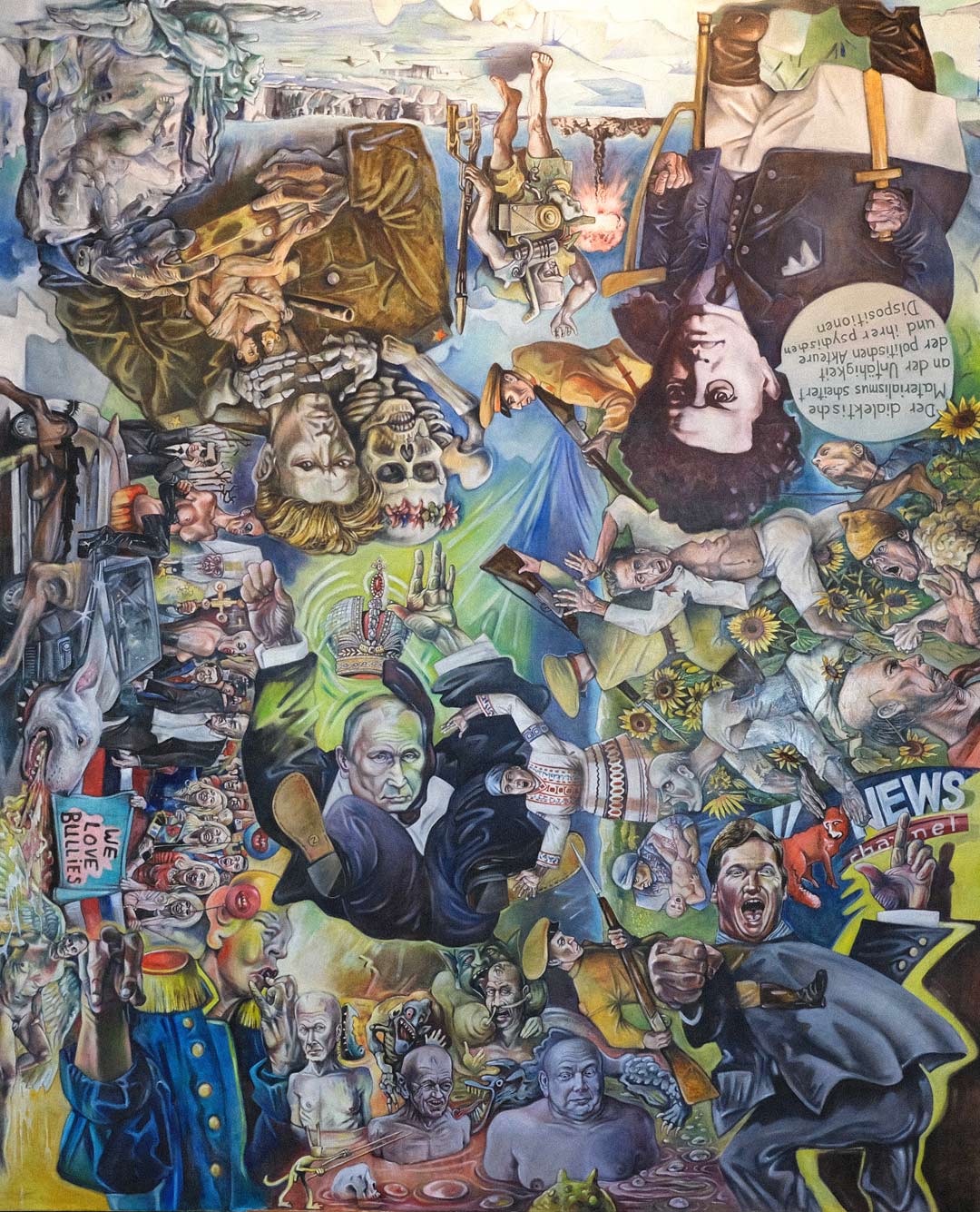
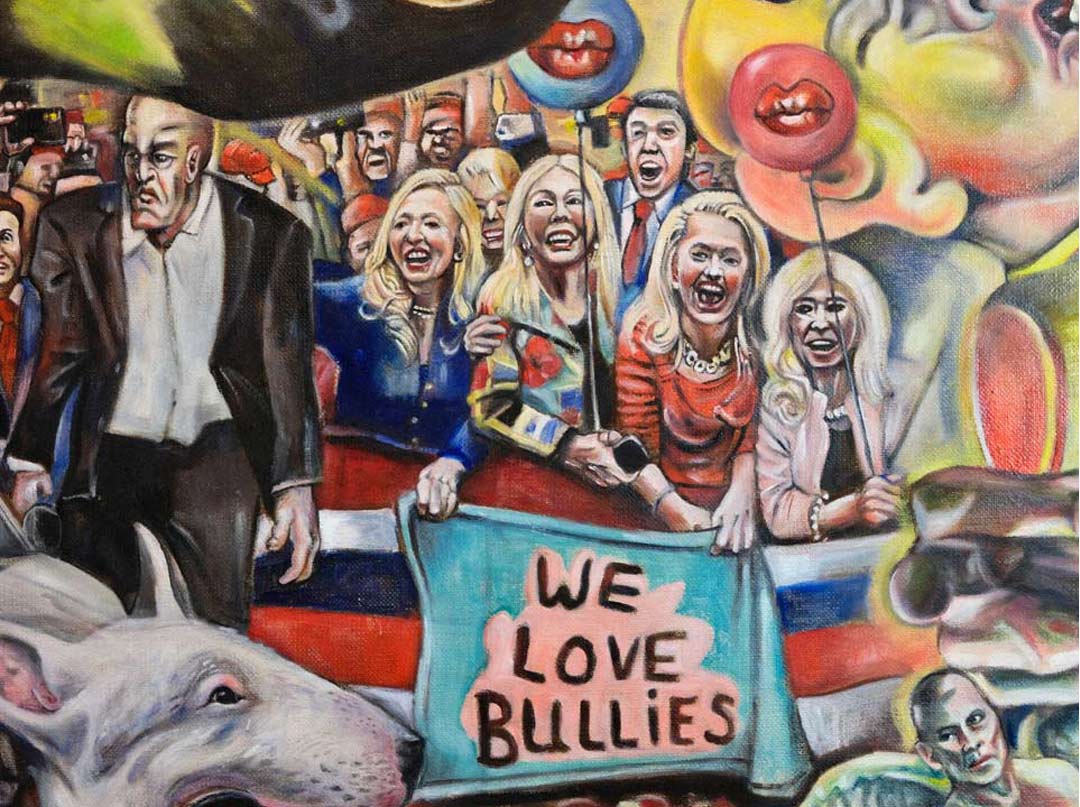
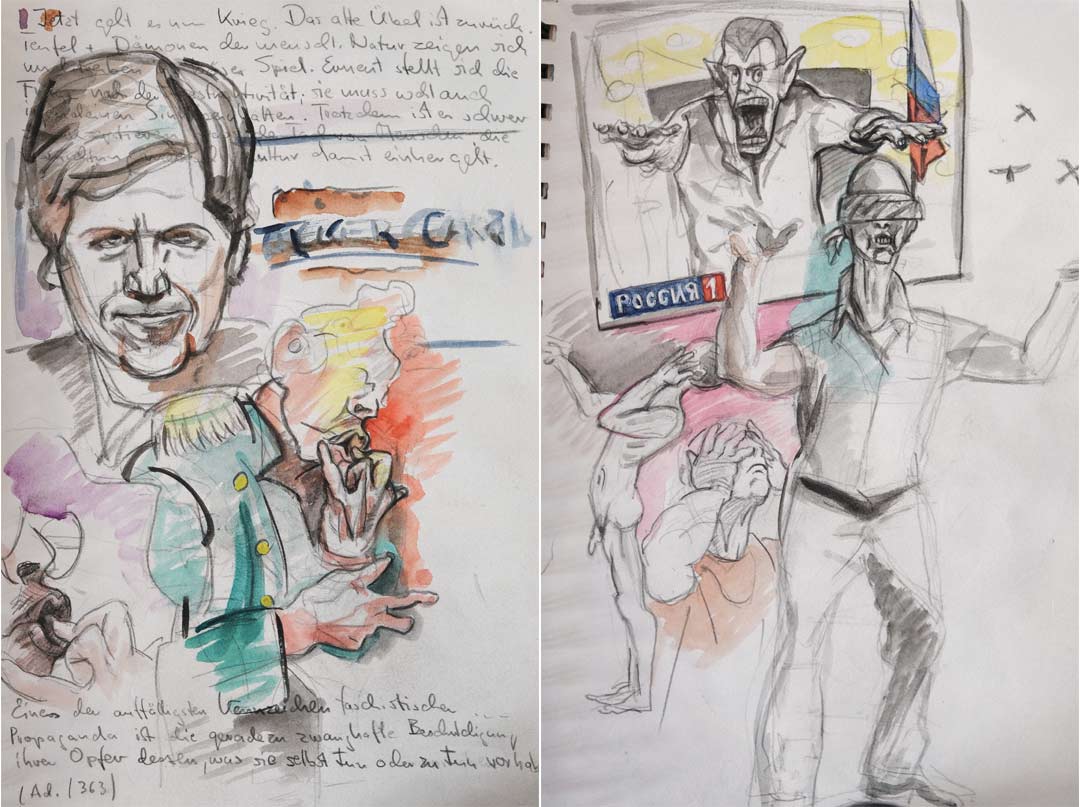
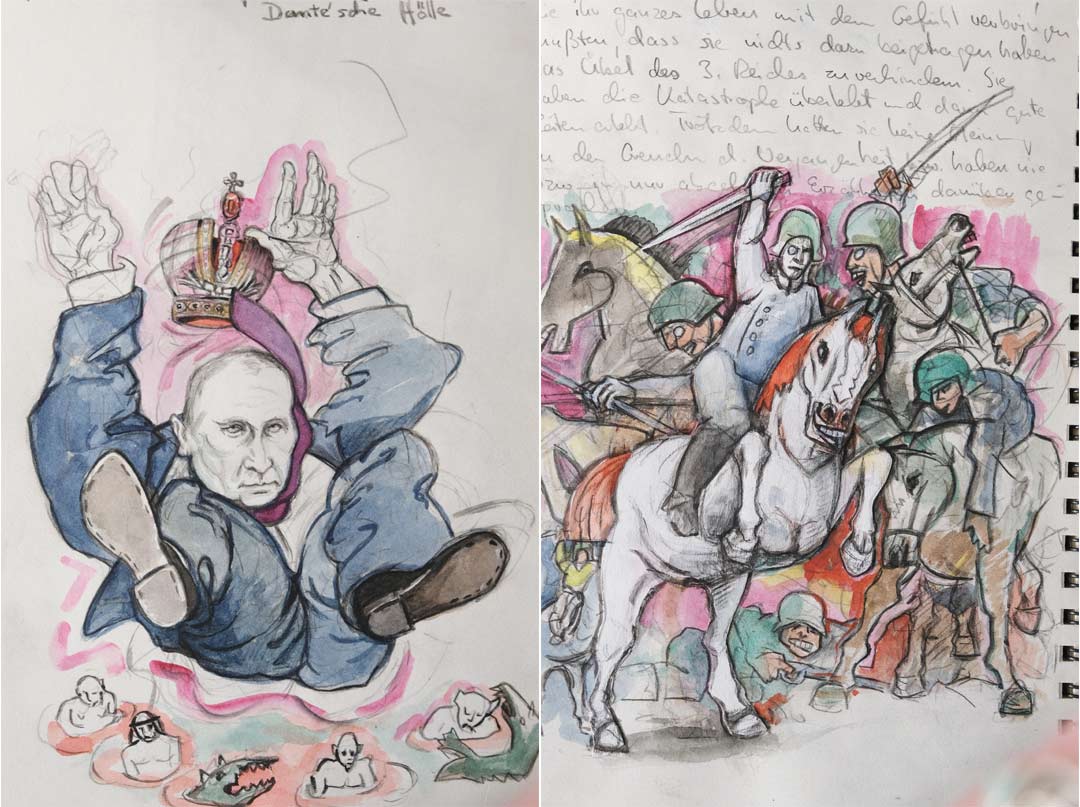
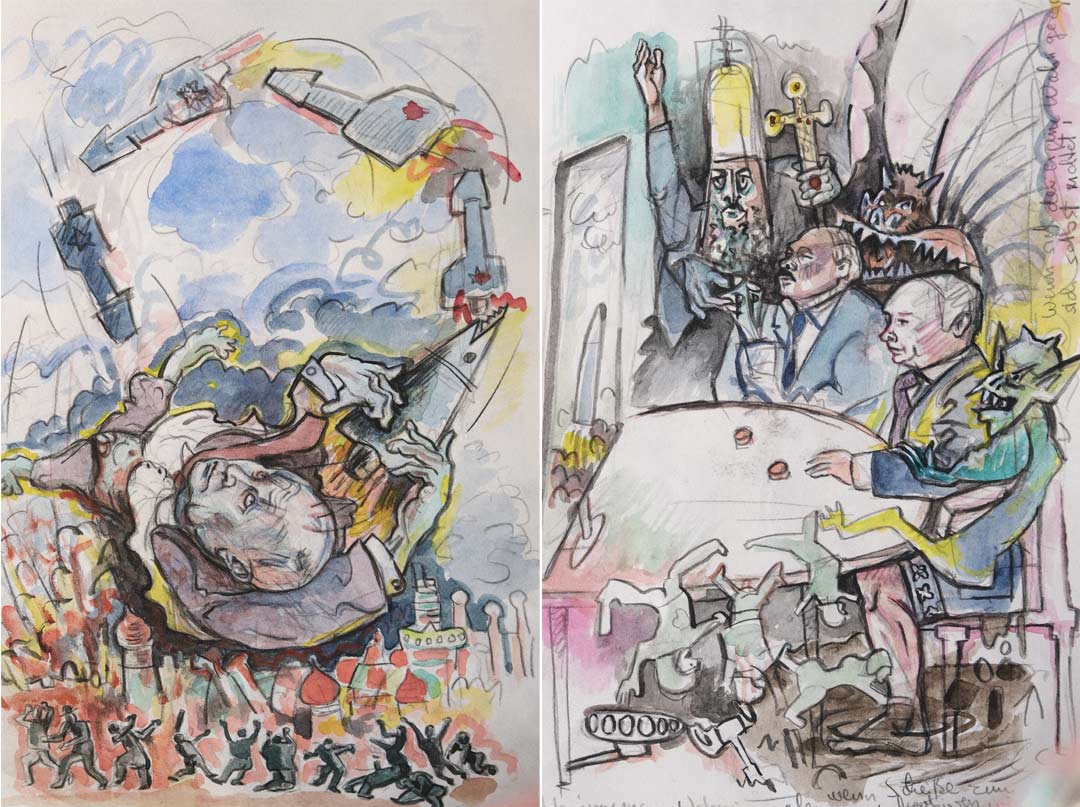
La Divina Commedia (170 x 140cm) Tempera/Oil on canvas. Title inspired by Dante Alighieri
The war in Ukraine began in 2014 with Russia’s annexation of Crimea and the subsequent conflict in eastern Ukraine, where pro-Russian separatists in the Donetsk and Luhansk regions fought against the Ukrainian government.
Russia’s full-scale invasion of Ukraine started on February 24, 2022. This date marks the beginning of the large-scale war, which continues to this day.
It has now been three years since Vladimir Putin launched his assault on Ukraine with his troops. The arguments behind it are well known. Putin, a nationalist and dictator, seeks to restore Russia’s dominance from before the collapse of the Soviet Union. For Russia to feel secure, it demands a buffer zone, for which the former Eastern Bloc countries must serve. One piece of this puzzle is Ukraine, the country where Putin began his campaign of reclamation.
The idea of a world divided among a few powerful, dominant nation-states has long been familiar. After World War II, there was hope that this patriarchal drive for control and power could be replaced by a peaceful and cooperative humanism in all respects. However, the formation of opposing blocs in East and West divided the world into spheres of influence, shaped by vastly different ideologies. When the Eastern Bloc suddenly collapsed in the late 1990s, it seemed that the Western way of life—democracy and a capitalist economic ideology—was expanding. Even Russia opened up, but it quickly fell under the influence of a few shady figures who enriched themselves excessively during the period of social upheaval, using mafia-like tactics. Meanwhile, Soviet-era political cadres and intelligence operatives began seizing control. Reactionary forces steered the country back toward an authoritarian power structure, where a small clique of power-hungry politicians and oligarchs dictated the course.
To maintain their privileges and control, they seek to end the influence of Western democracies and restore a past order. This is a dangerous anachronism—one that threatens to plunge the world into catastrophes similar to or even worse than those of the first half of the 20th century.
The caricature of Leo Trotzki in the painting is accompanied by a speech bubble that addresses two factors behind the failed revolution and Russia’s anachronism at the beginning of the 21st century:
„Dialectical materialism fails due to the incompetence of political actors and their psychological dispositions.“
The painting is designed in such a way that it can be viewed from all four sides, allowing for the discovery of new content and perspectives.
La Divina Commedia (170 x 140 cm) Tempera/Oil on canvas. Title inspired by Dante Alighieri
The war in Ukraine began in 2014 with Russia’s annexation of Crimea and the subsequent conflict in eastern Ukraine, where pro-Russian separatists in the Donetsk and Luhansk regions fought against the Ukrainian government.
Russia’s full-scale invasion of Ukraine started on February 24, 2022. This date marks the beginning of the large-scale war, which continues to this day.
It has now been three years since Vladimir Putin launched his assault on Ukraine with his troops. The arguments behind it are well known. Putin, a nationalist and dictator, seeks to restore Russia’s dominance from before the collapse of the Soviet Union. For Russia to feel secure, it demands a buffer zone, for which the former Eastern Bloc countries must serve. One piece of this puzzle is Ukraine, the country where Putin began his campaign of reclamation.
The idea of a world divided among a few powerful, dominant nation-states has long been familiar. After World War II, there was hope that this patriarchal drive for control and power could be replaced by a peaceful and cooperative humanism in all respects. However, the formation of opposing blocs in East and West divided the world into spheres of influence, shaped by vastly different ideologies. When the Eastern Bloc suddenly collapsed in the late 1990s, it seemed that the Western way of life—democracy and a capitalist economic ideology—was expanding. Even Russia opened up, but it quickly fell under the influence of a few shady figures who enriched themselves excessively during the period of social upheaval, using mafia-like tactics. Meanwhile, Soviet-era political cadres and intelligence operatives began seizing control. Reactionary forces steered the country back toward an authoritarian power structure, where a small clique of power-hungry politicians and oligarchs dictated the course.
To maintain their privileges and control, they seek to end the influence of Western democracies and restore a past order. This is a dangerous anachronism—one that threatens to plunge the world into catastrophes similar to or even worse than those of the first half of the 20th century.
The caricature of Leo Trotzki in the painting is accompanied by a speech bubble that addresses two factors behind the failed revolution and Russia’s anachronism at the beginning of the 21st century:
„Dialectical materialism fails due to the incompetence of political actors and their psychological dispositions.“
The painting is designed in such a way that it can be viewed from all four sides, allowing for the discovery of new content and perspectives.
Luigi Trenkler | Sketches Paintings Photographs | Graben 13/35, 1010 Vienna | Phone: +43 664 928 62 61 | E-mail: info@artbyluigitrenkler.net
Luigi Trenkler | Sketches Paintings Photographs | Graben 13/35, 1010 Vienna | Phone: +43 664 928 62 61 | E-mail: info@artbyluigitrenkler.net